USQ Cup Review
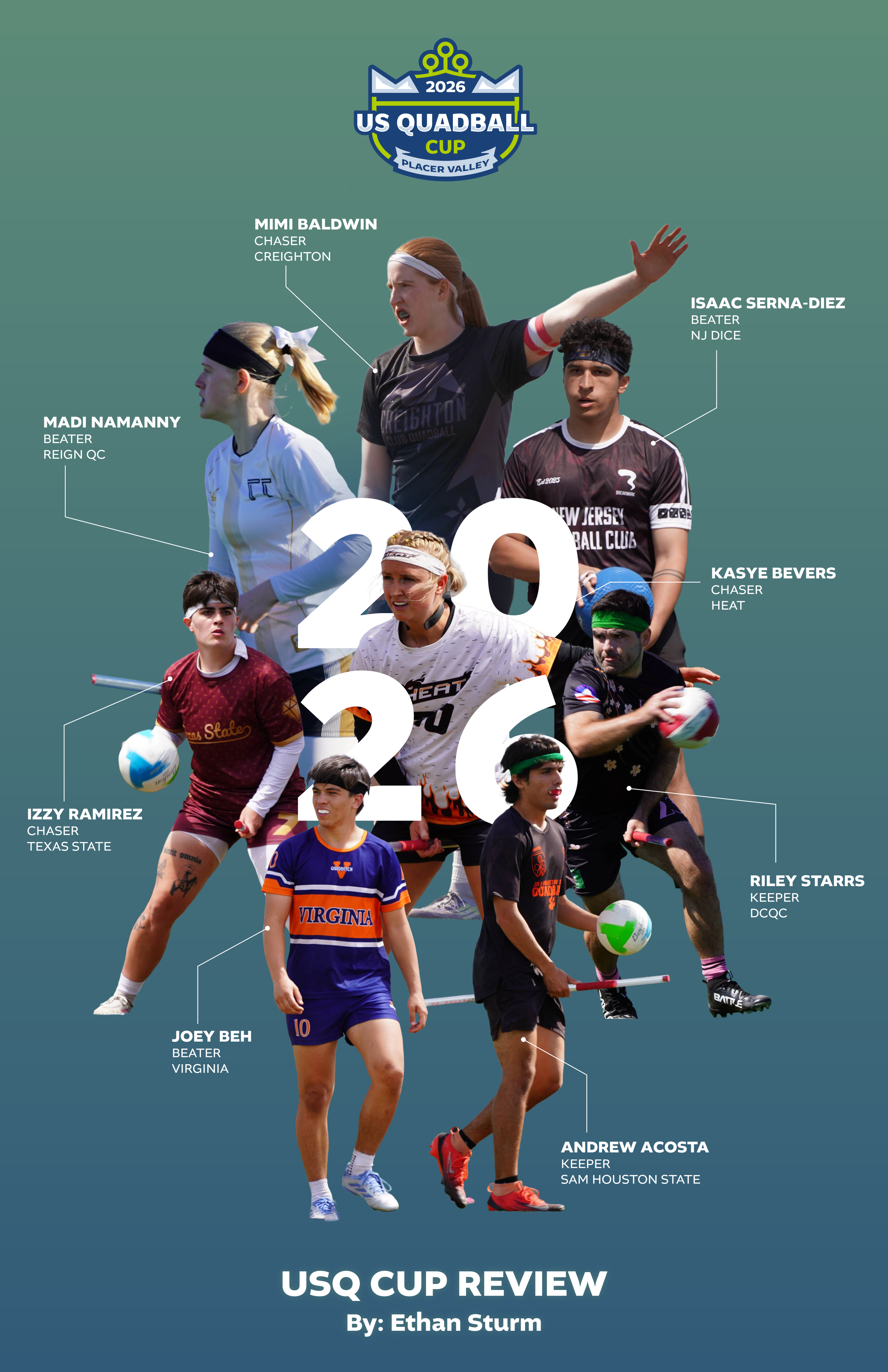
By Ethan Sturm
In many ways, US Quadball Cup 2026 felt like a return to form for the preeminent weekend of the sport in the United States. The first championship run under the tenure of CEO Amanda Dallas ran smoothly, efficiently and with minimal controversy. Many old faces made appearances for the first time in years, either to volunteer or simply to take the tournament in as fans. The venue was new and conducive to an event of this size. Both the college and club tournaments had plenty of Sunday drama, and saw deserving champions rise to the top.
But it also felt like something of a new beginning. With many of the sport’s greats playing their final US Quadball Cup in 2025, the door was open for new faces and new teams to jump through. And plenty of players did just that. In the end, Creighton University made a dominant run to its second straight title on the college side, while Texas Hill Country Heat won its second championship in a come-from-behind nailbiter over Boom Train in the club division.
With so much quadball played in just two days, it would be all but impossible to cover it in a single article. But here are some thoughts on the storylines that defined US Quadball Cup 2026.
The Heat of the Jay
Jay Stewart has become all but synonymous with quadball championship finals. He has played in three of the past four US Quadball Cup finals and in the last Major League Championship finals. In those finals, his teams have gone a combined 4-1 in individual games.
Those matches have seen all types of flows, from come-from-behind victories like UTSA’s win at US Quadball Cup 2023 to consistently dominant performances like the San Antonio Soldados’ 2025 MLQ title. But in this final, the game flow seemed to have gotten completely away from the Heat, who trailed Boom Train 90-30 ten minutes into the match.
After Riley Moehlmann – whose expanded role for Heat this weekend was vital to the team’s success – hit a pair of goals to shrink the deficit to 90-50, Stewart retrieved a loose ball in the defensive end and took off in transition. With no passing options, no armed beater in tow and Matt Brown staring him down from the defensive keeper zone, Stewart kept his composure and drilled a push shot into the small hoop from 10 yards out, swinging the momentum and forcing Boom Train into a timeout.
Boom Train immediately scored coming out of the timeout, and when Stewart’s shot from behind the hoops on the next possession was tipped, it seemed as though things were swinging back away from Heat. That is, until Stewart followed up his missed shot, got a hand on what was intended to be a handoff back to the Boom keeper, and kept the possession alive. A minute later, he ended that possession with a dunk.
Even with those heroics, Boom Train dominated the flag-runner-on-pitch period, building up a 150-100 lead in a game with a 170 set score while giving their seekers the majority of the looks at the flagrunner. Time seemed to be quickly running out on Heat when Stewart – who had at times over the past few years largely put seeking on the back burner to focus on chasing – stepped onto the pitch for his second shift of the game at the position. With his very first opportunity to attack the flag runner, he jumped high, reaching over the back and coming up with the grab. It was once again, game on.
After a Sammy Garza goal brought Heat within three scores of a title, Stewart subbed back into the game at chaser and did the rest. He started by simultaneously dunking over Nathan Digmann and Kennedy Murphy in a physics-defying single motion to get them within two. He followed it up by going by Vincent Reyes all but untouched on his way to a simple lay-up on the small hoop to bring them to game point. And he finished it on a patient, final possession, taking advantage of a single, small Nojus Ausra mistake and the help of a timely hammer play from Bailee Fields to drill one last push shot, calling game not just on the championship but perhaps on the conversation of best quadball player on the planet as well.
Stewart finished the finals with six goals and a flag runner catch, which he added to his three goals and a catch in a 155-100 win over New Jersey Dice in the semifinals. The win marked Stewart’s second USQ title to go with one MLQ title. He will almost assuredly be headed to the 2027 World Cup as a member of the USNT, where he could become the first player outside of the University of Texas-Austin to ever win a USQ Club, USQ College, MLQ and IQA title. And if his growing history is any indication, who would bet against Stewart starring in yet another finals come next July?
Finally, A (Mid)Western Championship
For much of the first decade of quadball, the Midwest struggled to gain a foothold on the national stage. While the Northeast and Southwest filled up trophy cases, the middle of the country had to content itself with a semifinal appearance here and a quarterfinal there.
But as the Creighton program flourished and the Chicago area grew over the past five years, there has been a seismic geographic shift in quadball. And the extent of that shift was on full display at USQ Cup 2026, where not only did Creighton earn its second consecutive title, but the University of Illinois made its first-ever semifinal and the University of Missouri outperformed just about all expectations to make the quarterfinals.
Early in Creighton’s quadball relevancy, the team had developed a reputation for choking at nationals. They only barely dodged that reputation in 2025, securing their first national title by holding off a massive comeback charge from the University of Virginia. With players like Madi Namanny, TJ O’Connor and Riley Usami leaving the program after the season, many doubted the team’s ability to go back-to-back.
But the team reloaded, thanks in part to the strength of the Blue Jay program they could call up from, and looked just as dangerous at nationals as they did last year. Beaters Derek Dearking and Ryan Cleary led the way, but it was the rising stars of Brynn Chang-Kanoa and Hunter Mogen, along with the already-expected play of Mimi Baldwin and Maddie Guillermo, in the chaser game that really tied the team’s potential together.
Creighton had its chance to get back to its choking ways in the semifinals, where Virginia led them for the majority of the flag-runner-on-pitch period. But the team showed its composure, built on the extensive infrastructure supporting the program at this point, dominating the beater game around the flag runner while winning in the quadball game, with Mogen supplying the grab that sent them back to the finals.
In the championship game against Texas State University, Dearking and Cleary were the story. The pair started the game with dodgeball control, and had never given it up once when Dearking subbed out 15 minutes later with a 100-50 lead. Texas State made its run at the end of the seeker floor, but nothing changed with the flag runner on pitch, as Dearking, now paired with Tiffannie Chang, never gave an increasingly desperate opposing seeker a chance. Soon enough, Guillermo was scoring the final goal, and Creighton became only the third school ever to win multiple USQ titles.
As impressive as the growing Creighton dynasty has been, the rise of the University of Illinois program may be even more so. A team that was not even on the national radar five years ago, that as recently as last year this writer had at the very bottom of his pre-nationals Div. 1 rankings, this year beat Virginia in pool play, made a national semifinal and gave Texas State everything they could handle in that semifinal.
When it came to this nationals run, everything was built on the back of the outstanding play of Sohum Sharma and Veronica Hoffman in the beater game. There wasn’t a beater pair in the tournament that could outplay them, and large periods of dominance against the likes of Texas State and Virginia allowed the team’s chasers to punch above their weight. Not that they really needed it, as Kevin Fantozzi – the sport’s foremost pump fake button spammer – and Elijah Mueller should be becoming household names with their ability to get to the hoop at will on offense while still delivering lockdown defense.
What’s most impressive about this Illinois team is the way it communicates. On pitch, there is always someone talking, and it’s rare to see this team’s offense or defense caught out of position. The team seems to always have a bespoke game plan for each matchup, and executes it well. To see a team like Virginia, who thrives in chaos, for the first time all season and beat them with a controlled, mistake-light playstyle is truly praiseworthy.
But while Creighton’s and Illinois’ presence at the top of the competition was expected, Mizzou’s was very much not. The team played only five official games all season – going 3-2 in them – and nothing about those games pointed towards a team that was ready for the nationals stage. But bolstered by a deep and physical chaser core and the sibling beater pair of Miles and Addison Himmelmann – which will not be flying under any radars going forwards after this weekend — the Tigers dominated both Brandeis University and Boston University on Saturday to qualify for the quarterfinals, where they gave Illinois all they could handle in a 125-70 loss, a massive improvement on their 205-40 loss to the same team just last month at qualifiers.
For a region that has spent much of quadball history as an afterthought, the performance of this trio of college teams, along with the finals appearance of Boom Train, was a historic one. And with the post-tournament announcement that USQ Cup 2027 will be in Omaha, Neb., there is no doubt that modern quadball now revolves around the Midwest.
Quick Hits
- Reign QC’s title hopes may have been derailed by an unfortunate Ryan Davis red card in the semifinals, but they were must-watch television all weekend long. Highlight reel plays all the way up and down the roster make for an incredibly fun brand of quadball that is worth the rewatch if you missed it live.
- Titus Chan continues to impress for Case Western, leading the team to an unexpected 9th place finish in Div. 1 with his high-level passing and shooting. He is expected to play his first MLQ season this summer, teaming up with Joseph Lombardi on the Cleveland Riff for an offense that should be a lot of fun to watch.
- New Jersey Dice, in their first year, has at times struggled with roster management in the biggest moments. At the Champaign Qualifier final, it was never getting Leo Fried off the bench for the entirety of the post-20 minute period. But in the USQ Cup semifinals, the team chose to rely heavily on Louis Sanchez, who had not played with the team all season, leaving talented options like Justin Cole and Vinnie Iannucci on the bench. The team will need to work on these inconsistencies if they hope to compete for a title in 2027, a goal they undoubtedly have the ability to make happen.
- Sam Houston may have been billed as the Andrew Acosta show coming into nationals. But the depth of their chaser game was the real story, allowing them to play competitive games all weekend long, including almost upsetting Virginia in the quarterfinals. Maddox Oldacre is a star in the making, and Spencer Quintana continues to shine right alongside Acosta. But perhaps most impressively, no one was able to bully them in the dodgeball game, a testament to the resolve of a young, unheralded beater core.
- In the end, Virginia’s title hopes weren’t doused by bad fouls or hotheaded play, but by their inability to do more than the exact thing they had done all year. A lack of resistance on the east coast this season may have lulled them into a false sense of security, but they seemed underprepared for teams that could handle their aggressive defense or for flag-runner-on-pitch situations in close games. The talent is undoubtedly there, and they will be a contender next season, but a couple trips out of region might be needed if they hope to finally win that elusive championship.