From Belgium to 2027: Well What’s Next?
By: Nicholas Love
Introduction
When the U.S. National Team landed in Brussels, Belgium, this July, the mission was clear: defend their legacy, win gold and prove once again why the United States National Team remains the pinnacle of Quadball. But the fourth-place finish at the 2025 IQA World Cup was far from the storybook ending players and fans had hoped for. For some, Belgium marked a farewell to the sport they love; for others, it was their first taste of competition on the world’s biggest stage. What’s certain is that the losses to Germany and Australia signaled the end of an era. At the same time, they ignited a new chapter for U.S. Quadball. Chapters defined by fresh leadership, evolving goals and new rules and expectations. In many ways, this turning point may be exactly what the program needs to reshape its future. Many heads turn to the USNT as they have a lot of questions to answer.
*For the purposes of this article, much of what I’m sharing simply reiterates existing USNT and USNTDA policies and practices. Some sections reflect my own interpretations and thoughts, especially since many of the new policies haven’t yet been fully explained or put into action. Ultimately, how the USNT and DA choose to implement them is beyond my pay grade. I’m just a guy writing in Google Docs for fun. Enjoy.*
End of an Era: All Eyes Turn to the Future
I’ve always believed that a team can only be as strong as the sacrifices its coaches are willing to make. The departure of USNT Head Coach, Michael Parada, exemplifies this; he knew when to step up, and when to step away. Parada took the helm of USNT Head Coach in 2017 after the U.S. fell to Australia in the 2016 games in Germany. Under his leadership, the team reclaimed gold in 2018 in Italy and defended home turf in 2023, cementing his place as one of the program’s most successful coaches.
Alongside Parada, assistant coaches Ethan Sturm and Jackson Johnson are also stepping down, closing a chapter of leadership that helped steady the program after 2016 and elevated U.S. Quadball back to the world stage. Sturm’s strategic vision in quadball is unmatched, drawing from both a deep understanding of the game and the culture of the sport, as well as a commitment to preparing players nationwide. Johnson, both as a player-coach and as a mentor for the USNT, helped shape numerous quadball players’ development. Their contributions extended far beyond wins and losses, laying a foundation that will continue to shape the sport’s future in the U.S. With their departure, a new era of leadership begins. One that will define the next chapter of the USNT.
Their exits create both a void and an opportunity for multiple coaches across the Quadball community to take the reins of a new-look USNT. On Dec. 3rd, Kennedy Murphy was announced the new Head Coach of the USNT, making USNT history by becoming the first woman to ever hold the position. Coach Murphy brings a wealth of coaching and winning experience at both the USQ (Boom Train) and MLQ (Chicago Prowl) levels. When scheduling conflicts prevented former Assistant Coach Ethan Sturm from attending the World Cup, Murphy was temporarily added to the USNT coaching staff. From the sidelines in Brussels, it would have been difficult to tell she wasn’t already a permanent fixture, at times looking like the USNT head coach by challenging officials on calls, guiding players through adjustments and providing strategic insight during lulls in play. Coach Murphy is looking to rebound from the 2025 IQA World Cup with her own new strategies and look for the USNT.
USNT Assistant Coach positions are now open and available and a few candidates stand out. Jack Levy boasts an impressive resume, with coaching roles spanning the University of Michigan, Detroit Innovators, New York Titans, The Warriors and the USNTDA at Quadball Nations Cup. Known amongst those that know him for his incredible ball knowledge, sources say Levy can’t go an hour without thinking or talking about Quadball. He has built a reputation as one of the sport’s most meticulous film analysts, studying both college and club for hours on end. For Levy, the question may not be whether he’s capable of helping lead the USNT to a gold medal, but rather whether he sees his impact as greater on the national stage or through continued development and scouting of young talent at the DA level. USNTDA coaching roles have also opened up for those interested in preparing the next generation of USNT stars.
Teddy Costa’s name was recently added to the hat, announced by Tyler Trudeau that Costa would be putting in an application for the USNT Head Coach role on the MLQ Networks hit show T-Time. Although the position was filled by Kennedy Murphy, I believe Teddy still could have a great impact on the program. Costa has had plenty of success as both a player, winning MLQ Championships with the Boston Forge in 2015 and 2016, a former USNT player, and as a coach helping with the various Boston programs, Houston Cosmos and Bosnyan Bearsharks. Costa could bring the scrappy and high intensity energy back to the USNT program from an era that previously had lots of success.
New Priorities. Same Mission
On July 29, 2025, the revised USNT goals and policies were released and formally approved by the US Quadball Board of Directors, Interim COO Shirley Lu and Hanna Reese.
The goals of the USNT are as follows.
1. “The US National Team Program members shall act as a visible marketing vehicle to grow the sport, recruit new players, and foster community engagement.”
This goal reframes the USNT as more than a collection of elite athletes across the country chasing medals, it positions the team as a representation of US Quadball as a brand. Under the direction of CEO Amanda Dallas, players are now charged with being ambassadors of the sport: modeling professionalism, representing Quadball positively, recruiting and developing talent and raising the sport’s visibility across the country. It signals a shift in emphasis from simply winning gold to also serving as the “gold standard” of Quadball.
2. “The US National Team Program staff shall ensure a clear and transparent selection process for players and coaches, with term limits and geographic/team diversity in selection.”
3. “The US National Team Program shall showcase talent representative of the U.S. member base, ensuring diversity in gender, geography, and teams.”
These two goals directly respond to longstanding concerns about roster decisions and staff appointments. For years, whispers of closed-door selections, player blacklisting, opaque tryout processes for teams that were already made, regional bias and unaccountable decision-making fueled skepticism around the USNT. The revised policies aim to change that by introducing term limits for coaches, requiring public applications for staff and establishing clear evaluation criteria for players. The standard term length for national team staff is now two years without reapplication for another two. The coach having to apply again could create turnover with varying visions for the USNT around how to create success. For players interested in joining the USNT or USNTDA, feedback is super important in ensuring a fair and transparent process. If a player believes the USNT selection or dismissal was handled unfairly, they have the right to appeal to the USQ CEO or the USQ Board of Directors for review, maintaining accountability and fairness at every level.
When it comes to geographic representation, progress can be seen in the USNTDA, where rosters feature greater gender inclusivity and geographic representation than in past cycles, highlighting talented players from smaller collegiate programs not traditionally dominant at USQ Nationals. At the USNT level, it remains to be seen how geographic diversity will be defined and implemented. Will there be structural guidelines in place from the start to ensure opportunities are distributed across regions in the United States? Or will adjustments only be made after rosters are finalized and concerns about regional bias are raised? In the last World Cup cycle, the roster leaned heavily toward players from the East and South, which may have limited opportunities for athletes in the West and Midwest. With the introduction of new policies, will the emphasis create greater access for underrepresented regions, or simply shift limitations?
4. “The US National Team Program staff shall assemble the best possible team to compete internationally and bring home gold medals.”
At its core, the USNT’s mission remains unchanged: win gold medals. The program exists to bring together the best 25 players in the country and compete for gold against the world’s top teams. Declaring this so clearly matters, because as the program shifts toward marketing, representation and transparency, competitive excellence must remain the anchor that holds everything together. Extensive discussions surrounding the newly implemented policies put into question whether the USNT can truly bring the best 25 players but we’ll have to wait for the new standing team and IQA competition roster to decide if the policies are conducive to producing winning results.
New Policies: Arguably the biggest changes from the updates and revisions are the new policies that impact player eligibility for the future of the USNT.
1. “No more than 50% of National Team athletes may identify as the same gender.”
A rule I can’t imagine many people are upset about. Quadball is a mixed-gendered sport where no matter how you identify, you belong in this sport and within our community. The rule also puts pressure on roster decisions across gender lines and creates more space to add more non-binary and gender non-confirming players to the roster while at the same time balancing and providing meaningful playing time for all players. These safeguards and barriers protect and encourage the diversity in gender that excels and dominates in our sport as well as highlighting players of all genders, because that's what makes our sport special.
2. “No more than 4 USNT players may share the same USQ team affiliation. In the transition period between IQA World Cup 2025 and IQA World Cup 2027, 4 USNT players may exceed this cap. (Team affiliation will be determined by the last US Quadball team the athlete rostered for.)”
This policy, as written, is inherently unclear and extremely contradictory to stated goals of the USNT and will likely need clarification from USNT staff as to the direction they will go and measures to adhere to both the goals and policies. The first key question is whether it applies to standing teams or to competition rosters. My initial assumption is competition rosters, but it would be helpful to confirm. When I first read the rule, I interpreted it as:
“A maximum of four players may come from a single team, but this cap can increase to five if another USNT or DA player from that team is called up for the IQA roster.”
However, after discussing it with others, I learned some people read it as:
“A maximum of four players may come from a single team, but this cap can increase to as many as eight if additional USNT or DA players from that team are called up for the IQA roster.”
My response to that second interpretation is: what’s the point? If nearly a third of the IQA roster could come from one team, doesn’t that undermine the stated purpose of promoting geographic diversity? And that’s without even considering that another strong team 20 miles away could account for four more spots (i.e. Texas Hill Country Heat & Texas Copperheads), suddenly 12 of the 25 roster slots might come from just two teams, which I believe the intent of the rule is trying to prevent. The USNT coaching staff could decide to take two extra players from Heat, one from Boom and one from Reign, but I think having clearer external expectations of the rule would help guide its intent.
A lot of players play for the same USQ teams as their friends. Let's use Reign QC as an example. Reign came together through a lot of great players saying “Let’s relive our college days at Creighton with a few editions and win a USQ Championship.” So far they’re undefeated and looking like a top contender to take home the USQ Cup. Current players in the USNTDA / USNT circle are 11: Ryan Mehio, Kyzer Polzin, Darian Maurecik-Ellis, Joe Goulet, Riley Usami, Lauren Smith, Lauren Curry, Miguel Esparza, Madi Namanny, Ryan Davis and Annika Kim. Per the current rule you could only take a handful (4, 5 or 8 depending on your reading) of these players. If more of these players wanted to be included on a World Cup roster, they’d need to play on a different team, away from their friends. It doesn’t seem fair to punish people for wanting to play with certain people. That undermines the USNT bringing their most competitive roster to compete for gold.
I believe that this rule also isn’t necessarily for the formation of the national team but rather for parity within USQ. Players on teams like Boom Train, Heat and Reign who are on the USNT or DA have tough decisions to make. For example, if you have seven current USNT players on your team, USNT hopefuls might have to make some splits. If you have aspirations of playing for the USNT, you have a better shot playing with two or three USNT caliber players on a team rather than a stacked roster with five. If people do decide to swap teams or create diffusions, younger players and hidden gems buried in depth charts of dynasty teams have more opportunities to play. But the question still stands: why should people have to choose or make a different team if they want to play for the USNT?
3. “National Team players can only be on 2 World Cup rosters over a 5 year period. Coaches can make an exception for up to 3 players who do not meet this requirement. Coaches are recommended to follow a similar policy for National Team Development Academy players.”
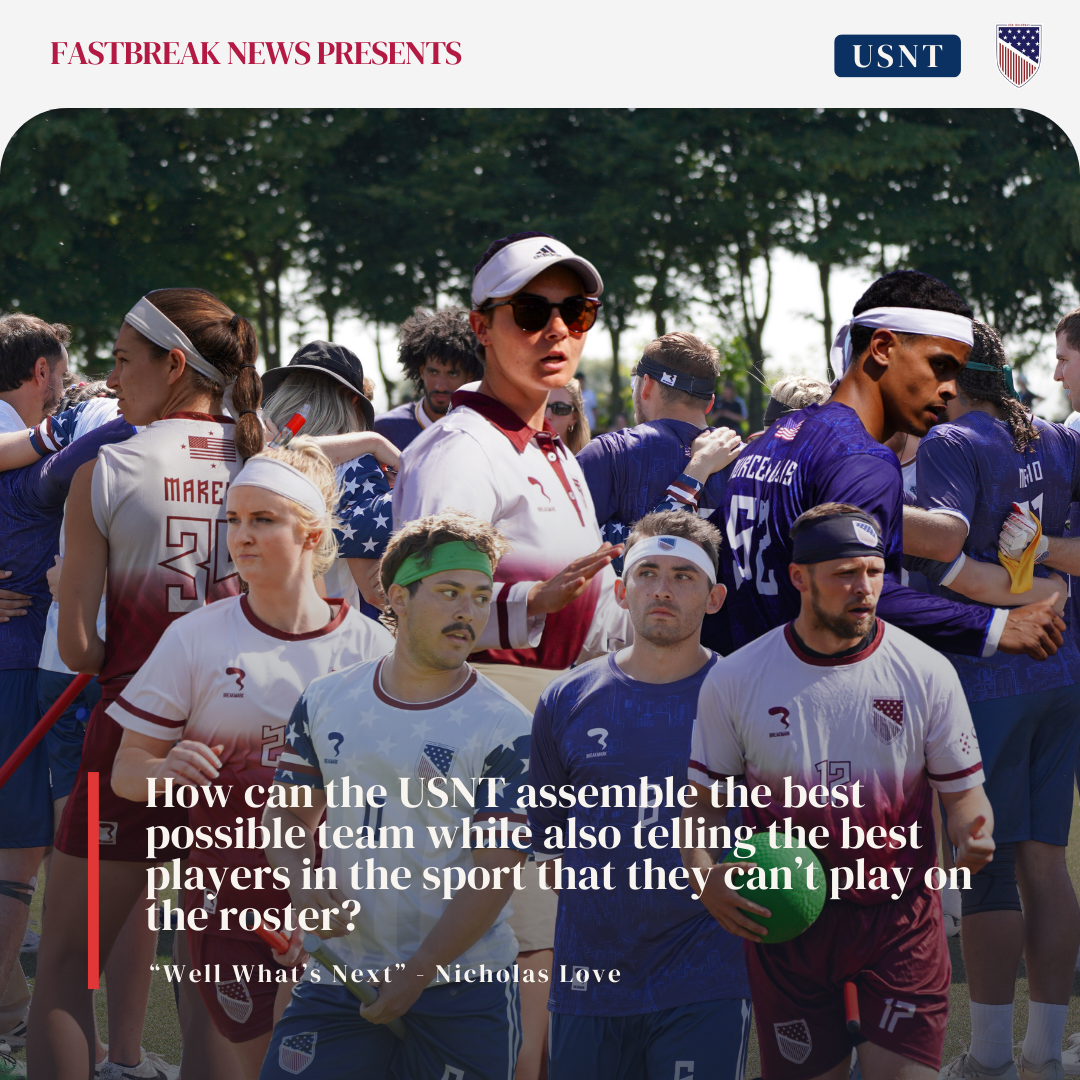
Easily the most controversial policy for the USNT is this last rule. In essence, a player does not have the ability to participate in three straight world cups and would have to take a cycle off before coming back to the team. The rule forces natural turnover with more opportunities for players to play at IQA. When you first read the rule it sounds cool. More turnover and opportunities for different players to compete in IQA Quadball and compete for gold medals. Then the more you think about the rule it’s hard to see how it aligns with the new goals of the USNT: “The US National Team Program staff shall assemble the best possible team to compete internationally and bring home gold medals.” The emphasis in that message being “the best possible team,” and then you look at the current standing roster of the USNT and say you’re going to lose Lindsay Marella, Bailee Fields, Miguel Esparza, Leo Fried, Louis Sanchez, Darian Murcek-Ellis, Matt Brown, Daniel Williams, Ryan Davis and so many more who have become household names in the sport. How can the USNT assemble the best possible team while also telling the best players in the sport that they can’t play on the roster? USNT has the three exceptions to this rule, but who do you decide to prioritize? Do you prioritize rostering older players in the sport that might be retiring soon to allow for younger players to reset and be available for future years? Do you prioritize beaters and potential USQ and MLQ pairs that have great chemistry? How would this affect gender balances in the future? There are so many questions and I wish I had the answers but until the USNT updates their standing roster and competition roster, those decisions are nothing short of speculation.
What I do know for a fact is that other countries and IQA teams are not doing this. Both watching and playing at IQA, top teams like Belgium, Germany, Australia, France and England are teams that run like professional programs. They play year round in various IQA and European tournaments and against their version of development academies regularly. Pound for pound I would take the USNT over any team in this world, but teams didn’t beat the USNT off of physicality and brute force but rather chemistry, great cuts, team play and most importantly clean Quadball. If the USNT operates similar to a fantasy tournament with pickup style Quadball and high turnover based on this new rule, then it’s hard to compete with teams who are always playing with each other. That doesn’t discredit all of the yearly training camps and preparation leading up to the actual IQA World Cup, but it’s just not the same. This new rule creates a larger margin of difference between the USNT and other programs.
With all the negative responses and USQ being open to listening to the community, I do see a possible amendment to the rule if they decide to keep it. I don’t want to sit here and critique the USNT without also offering some type of solution. 25 people make the competition roster but only 21 players touch the field in international Quadball play. 21 players saw minutes against international opponents and varying strategies and playstyles against different IQA teams. Out of those 21 players, in games that were more competitive, (i.e. the semi-finals match against Germany and the third place match against Australia) only 17 of the 21 saw the field. These four “reserve” players that didn’t see play in high level games could have protection against the rule that takes away eligibility for those players. That means if this rule amendment was to be implemented, Javien Stewart, Ryan Mehio, Kayse Beavers and Kyzer Polzin would be protected and maintain their eligibility for another two World Cups. This protection would only be able to work once to still maintain the purpose and intent of the rule, while also still giving meaningful opportunities for players to compete on the world stage.
It’s not just on the USNT, it’s on us too
As a player for African Nations during the IQA tournament, it became very clear that the rest of the world is headhunting the USNT. With the dominance that U.S. Quadball showed throughout the 2010s, there’s a certain target on their back. During the semifinal match against Germany, if you weren’t actively playing, you were at that field. India and African Nations had a scheduled game, but we both agreed that we weren’t going to start until the US v. Germany game was over. The atmosphere around that pitch was “Everybody vs. U.S. Quadball.”
You had people in Belgium openly rooting against the U.S., even those I know are close friends with players on the USNT. Online, both before and after the tournament, frustration and backlash flared over roster construction, playing time and coaching decisions. And I get it, those choices are bound to spark heated conversations, and people have every right to question or critique them. But at the end of the day, U.S. Quadball sent 30 athletes and coaches overseas, each of them spending thousands of dollars and years of preparation for this moment. For many, it marked the final international run of their careers. Countless hours of training, sleepless nights and season-ending injuries, all of it was overshadowed by negativity from within their own community.
As a Detroit Lions fan, I know what it’s like to be frustrated. I’ve watched my team consciously find ways to lose every Sunday for most of my life. I’ve been upset with management, players and coaches. But every Sunday, I still turn the TV on because I support my team through the good and the bad. I’m not saying people have to be ride-or-die USNT fans, or that criticism should disappear. But I do believe the sport deserves respect, and the players deserve support. They should know that behind them is a community that believes in them, that wants to see them succeed and that shows up for them no matter what.
.Potential Roster
*Disclaimer: The roster decisions below are entirely speculative, based on current player availability, performances over the past few years and tournaments, possible retirements and projected 2025 USQ affiliations. It’s also worth noting that, under the current rules, players not protected by the “keep” rule would be ineligible until 2029, a long time from now. I did my best to research updated USQ rosters with the information available, but since affiliations will almost certainly change over the next two years, I didn’t weigh that rule as heavily as the others.
I also didn’t factor in speculation about player development; if I had, I’d probably include a few current USNTDA players and some other fringe players (and if you’re curious who, my DMs are open). Building a competition roster under the new rules was especially difficult, so I prioritized players with eligibility from the previous IQA roster.
If you believe you should be on the USNT Standing Team and don’t see your name here, I’m sorry, I just don’t know ball. There were a lot of tough cuts I didn’t want to make, and honestly, I’m glad I’m not the one actually tasked with finalizing the roster.
I also correctly predicted the Head Coach position before the announcement was made. Check with the editorial staff for confirmation that I know what I’m talking about.*
USNT Competition Lineup
Head Coach: Kennedy Murphy
Assistant Coach: Teddy Costa
Playing Assistant Coach: Hayden Boyes
Team Manager: Hanna Reese
Team Assistant Manager: Joan Boyes
Beaters
Kasye Bevers │ Texas Hill Country Heat
Lauren Curry │ Reign QC
Celine Richard │ Carolina Reapers
Nojus Ausra │ Boom Train
Rei Brodeur │ Boom Train
Ryan Hsu │ Boom Train
Kyzer Polzin │ Reign QC
Baldemar Nunez │ Texas Copperheads
Chasers
Hayden Boyes │ Texas Copperheads
Ryan Mehio │ Reign QC
Jay Stewart │ Texas Hill Country Heat
Darian Murecik Ellis │ Reign QC
David Avila II │ Texas State Quadball
Leo Fried │ NJ Dice
Nathan Digmann | Boom Train
Joe Goulet │Reign QC
Emma Persons │ Boston Lobsters
Molly Potter │ NJ Dice
Lauren Smith │ Reign QC
Emma Vasquez │Chaos Quadball Club
Annika Kim │ Reign QC
Alyssa Villalba │ Texas Hill Country Heat
Ally Manzella │ Boom Train
Izzy Ramirez | Texas State Quadball
Lindsay Marella | NJ Dice
USNT Standing Players
Beaters
Derek Dearking | Creighton
Keighlyn Johnson | Chaos Quadball Club
Madi Namanny | Reign QC
Adrian Koretsky | DCQC
Chasers
Milena Sousa | Texas Hill Country Heat
Justin Cole | NJ Dice
Max Mier | TCQC
Riley Usami | Reign QC
Mimi Baldwin | Creighton
Chantal Siodlarz | UVA
Matt Blackwood | Texas Hill Country Heat